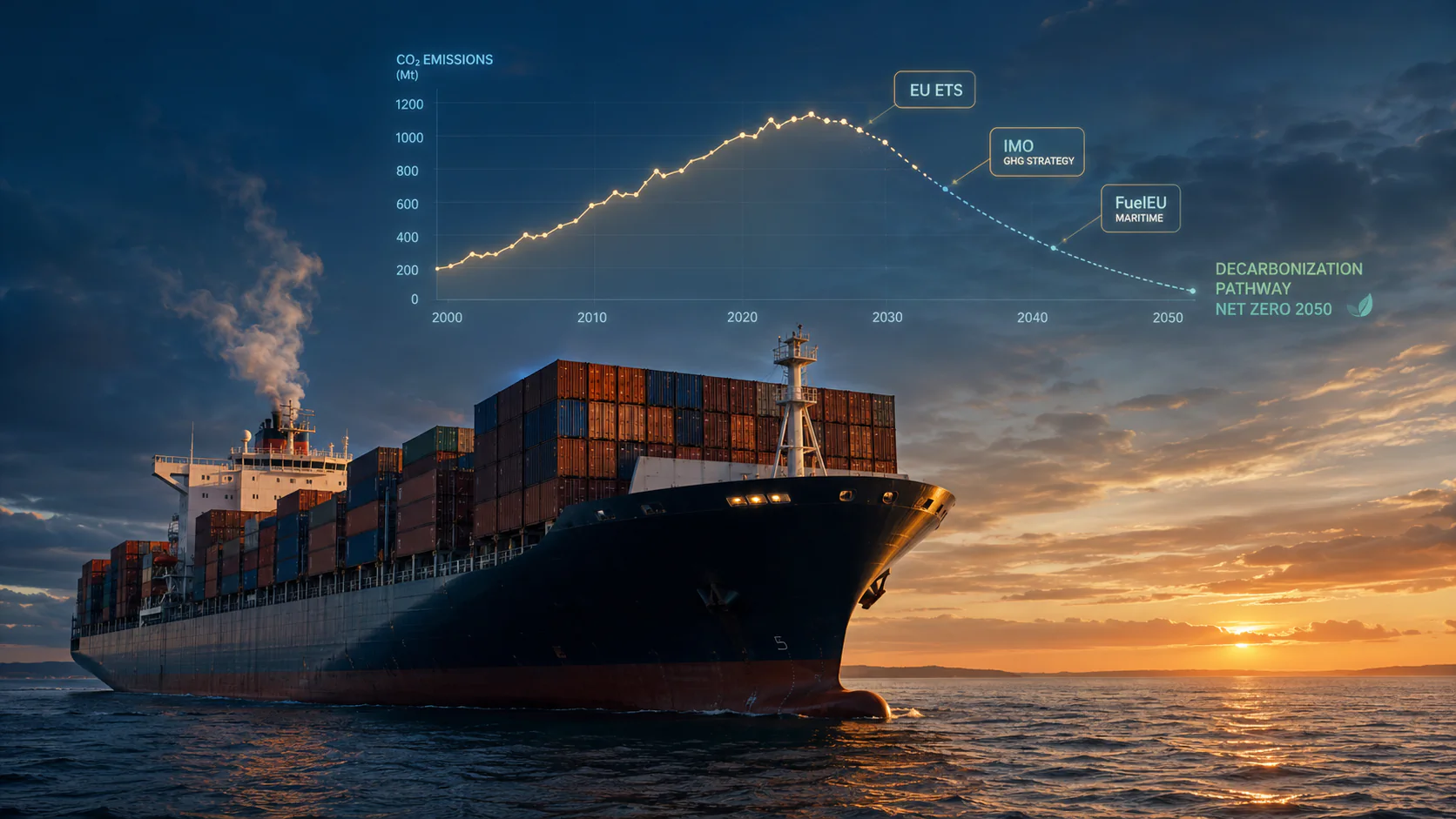
In April 2026, the IMO held its 84th session of the Marine Environment Protection Committee (MEPC84) in London and adopted the Net-Zero Framework (NZF): the most ambitious global carbon pricing system for shipping to date. For European operators already navigating EU ETS and FuelEU Maritime, this is an additional layer with direct impact on costs, contracts and fuel strategy.
1) What MEPC84 adopted (and why it survived)
The session was marked by pressure from a coalition of flag states to weaken or delay the NZF. The final outcome was adoption with two pillars:
- Global Fuel Standard (GFS): mandatory fuel carbon intensity cap (gCO₂e/MJ), with a base and a more ambitious target trajectory. Phased entry from 2027/2028.
- Levy mechanism: vessels exceeding the GFS limit pay a penalty for excess emissions. Revenues go to a transition fund and compensation for SIDS and LDCs.
Key milestones: 20–30% GHG intensity reduction by 2030, 70–80% by 2040, net-zero by 2050.
2) The 5 regimes now coexisting for European operators
- IMO CII in force since 2023. Annual A–E rating on CO₂/tonne·mile ratio.
- IMO GFS new from MEPC84. Fuel carbon intensity cap with levy. Entry: 2027/2028.
- IMO Levy linked to GFS. Estimated USD 40–100/t CO₂e, escalating progressively.
- EU ETS Maritime in force since 2024. 40% EUAs (2024), 70% (2025), 100% from 2026.
- FuelEU Maritime in force since 2025. Lifecycle carbon intensity cap with penalties and pooling.
Key note: the IMO foresees equivalence mechanisms with EU ETS, but details are still being negotiated. Until clarity emerges, assume exposure to both systems.
3) Practical impact by role
Shipowners and fleet managers
- Fuel profile under triple scrutiny: EU ETS charges for actual emissions; FuelEU requires lifecycle intensity; GFS sets another threshold with its own levy.
- TC contracts: review compliance cost allocation clauses (EU ETS, FuelEU, NZF levy).
- CAPEX/OPEX: the NZF levy adds further economic incentive to transition to alternative fuels.
Bunker traders and fuel suppliers
- Customers now buy "compliance bundled": not just price/mt, but lifecycle carbon intensity and GFS compatibility.
- Biofuels and RFNBO: traders offering traceability and certification (ISCC, RSB) will have a competitive edge.
Fleet managers and chartering managers
- Integrated compliance reporting: consolidate CII, EU ETS (MRV), FuelEU and GFS into one dashboard.
- FuelEU pooling: the window to organise 2026 pooling is now.
4) Action timeline 2025–2028
- 2025 (already active): FuelEU Maritime + EU ETS at 70%.
- 2026: EU ETS at 100%. Time to audit TC contracts.
- 2027–2028 (projected): GFS entry into force and NZF levy start.
- 2030: first NZF checkpoint (20–30% reduction).
5) What does NOT change with MEPC84
- EU ETS Maritime does not disappear. Both systems coexist.
- FuelEU Maritime remains in force.
- CII remains mandatory with its A–E rating system.
6) Immediate action checklist
- Review TC contracts: does a clause allocate EU ETS costs and the NZF levy?
- Audit 2026 fuel profile: which vessels are simultaneously at risk under FuelEU and CII?
- Evaluate FuelEU pooling: the window to organise 2026 pooling is this semester.
- Update MRV/reporting to incorporate GFS metrics.
- Require lifecycle traceability from bunker suppliers.
- Train your teams on the 5 regulatory frameworks: chartering, technical and finance staff need to understand how EU ETS, FuelEU, CII, GFS and NZF levy interact.
7) What Maritime Nexus does
At Maritime Nexus Academy we offer practical training on the regulatory frameworks most impacting European operators today: EU ETS, FuelEU Maritime and maritime decarbonisation. Not abstract theory — applicable criteria, real cases and analysis tools.
Note: This content is informational and does not constitute legal or financial advice. NZF dates and figures are projected from MEPC84 agreements; final regulations may vary.