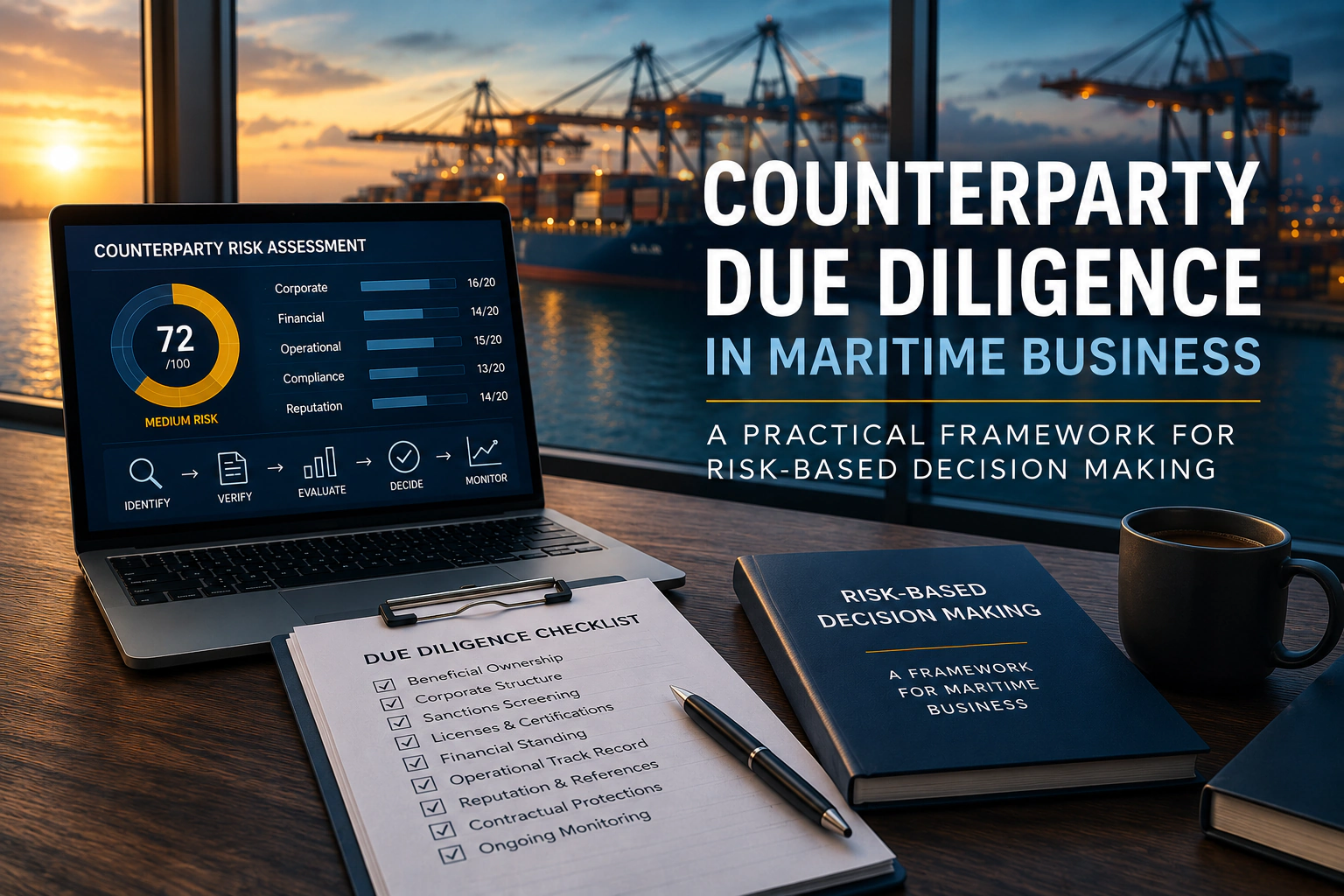
In maritime business, a transaction can look commercially attractive and still carry significant risk. A competitive freight rate, an available vessel or an urgent cargo opportunity does not remove the need for a structured counterparty review. In many cases, major losses do not begin with a bad freight rate. They begin with a poorly assessed counterparty.
Maritime Nexus Academy turned this article's framework into a hands-on interactive course: Counterparty Due Diligence Framework, with a Risk Score, Checklist and Decision Tree you actually use, not just read about.
Shipowners, charterers, brokers, traders, port operators, suppliers, insurers and financiers operate in an environment where risk is no longer purely operational. A counterparty may create exposure to sanctions, payment default, false documentation, opaque ownership structures, compliance failures, negative market reputation or a genuine inability to perform.
This Maritime Insight provides a practical framework for assessing counterparties in maritime transactions. It does not replace legal, financial, insurance or compliance advice. Its purpose is to help maritime professionals structure their analysis, ask better questions and document decisions before committing to a transaction.
1) What counterparty due diligence means
Counterparty due diligence is the process through which a company identifies, verifies and evaluates the person or entity with whom it intends to do business. In maritime transactions this may include a charterer, shipowner, disponent owner, broker, trader, shipper, receiver, agent, bunker supplier, port operator, offshore company or any other relevant third party in the contractual chain.
The objective is not absolute certainty. In maritime commerce that rarely exists. The objective is to reduce uncertainty to a level that allows a reasoned decision: proceed, proceed with conditions, escalate the matter for higher review or reject the opportunity.
A sound review should answer five basic questions:
- Who is the counterparty really?
- Does it have legal and commercial capacity to act?
- Does it have the operational and financial ability to perform?
- Is there sanctions, regulatory or reputational exposure?
- What contractual or commercial controls are required before proceeding?
2) Due diligence is more than sanctions screening
A frequent mistake is to reduce counterparty due diligence to checking whether a company appears on a sanctions list. That check is necessary, but it is not sufficient. A counterparty may not be sanctioned and still present high risk due to financial weakness, operational incapacity, poor documentation or negative market reputation.
OFAC maritime sanctions guidance encourages maritime stakeholders to identify evasion patterns, conduct appropriate checks and maintain adequate compliance controls. BIMCO also makes clear that it does not conduct due diligence on behalf of its members and that companies must establish their own review processes. P&I Club guidance and international compliance practice reinforce the same principle: due diligence should be proportionate to the risk of the transaction.
A serious assessment should therefore integrate at least four dimensions:
- Identity and ownership: Who actually controls the entity.
- Compliance and regulation: Sanctions, restrictions, licensing and jurisdictional exposure.
- Commercial and operational capability: Experience, track record, resources and execution ability.
- Financial and reputational risk: Solvency, references, known disputes and market behaviour.
3) The Maritime Nexus approach: identify, verify, evaluate, decide and monitor
For practical use, Maritime Nexus recommends a five-stage cycle. It is not presented as an official industry standard, but as an operational decision-support model based on compliance practice, risk management principles and maritime commercial experience.
Identify → Verify → Evaluate → Decide → Monitor
Stage 1: Identify
The first question is simple but critical: Who are you really dealing with? In maritime business, the trading name presented during a negotiation does not always reveal the full structure behind the transaction. Related entities, intermediary companies, beneficial owners, managers, disponent owners, sub-charterers or cargo interests may need to be understood before a fixture is concluded.
At this stage, the company should collect basic information: Legal name, jurisdiction, corporate registration, address, main business activity, authorised representatives, ownership structure, beneficial owners where possible, role in the transaction and relationship with other parties.
Stage 2: Verify
Identification is not enough. The information should be verified against reasonable sources and consistent documentation. Verification may include corporate registries, public databases, incorporation documents, powers of attorney, commercial references, certificates, official websites, market background checks and screening tools where available.
Where the counterparty is involved in a higher-risk transaction for example sensitive trades, higher-risk jurisdictions, regulated cargoes, opaque structures or routes under scrutiny, verification should be more extensive.
Stage 3: Evaluate
After verification, the company must evaluate the risk. This is where many organisations fail. Possessing documents does not mean the risk is acceptable. The review should consider whether the counterparty can perform, whether its track record is reliable, whether the transaction is consistent with its profile and whether red flags are present.
The evaluation should cover commercial, financial, operational, contractual, regulatory and reputational risk. It should also consider the specific transaction. A recurring low-risk relationship is not the same as an urgent fixture involving sensitive routes, several intermediaries and limited documentation.
Stage 4: Decide
Due diligence should lead to a clear decision. It is not enough to state that a party has been “reviewed”. The outcome should place the transaction into one of four decision categories:
- Proceed: Low or acceptable risk. The transaction may move forward with normal controls.
- Proceed with Conditions: The transaction may proceed subject to additional documents, guarantees, specific clauses or enhanced monitoring.
- Escalate: Legal, compliance, P&I, senior management or external advice is required.
- Reject: The risk is unacceptable or the counterparty fails to provide sufficient information.
Stage 5: Monitor
Monitoring is essential. A counterparty’s situation may change during the contractual relationship. New sanctions, ownership changes, route changes, financial problems, commercial disputes or operational behaviours may alter the original risk profile.
For higher-exposure transactions, monitoring may include changes in corporate control, AIS behaviour where applicable, voyage documentation, port changes, cargo-chain changes, relevant news and communications that suggest inconsistencies.
4) Common red flags
Red flags do not always mean that a transaction must be rejected. They do mean that further review is required before proceeding.
- The counterparty pressures the parties to close without providing basic documentation.
- The company was recently incorporated and has no verifiable track record.
- The corporate structure is unnecessarily complex for the proposed transaction.
- Documents contain inconsistencies in names, addresses, dates or representatives.
- The counterparty uses non-corporate email accounts for a high-value transaction.
- There are no verifiable commercial references.
- The transaction involves jurisdictions, routes or cargoes under heightened scrutiny.
- There are last-minute changes to shipper, receiver, port, vessel or documentation.
- The counterparty refuses reasonable sanctions, compliance, termination or documentation clauses.
- Publicly available information does not match what has been declared during the negotiation.
5) Practical risk matrix
To support consistent decisions, Maritime Nexus recommends reviewing each counterparty across five categories. The purpose is not to turn commercial judgement into an automatic formula, but to prevent commercial pressure from obscuring obvious risk.
| Category | What to review | Expected result |
|---|---|---|
| Corporate identity | Registration, representatives, beneficial ownership, jurisdiction, structure | The counterparty exists, is identified and its role is clear |
| Compliance | Sanctions, restrictions, licensing, contractual clauses | No obvious exposure or exposure is controlled through suitable safeguards |
| Operational capability | Experience, resources, track record, execution, technical documentation | The party can perform what it promises commercially |
| Financial reliability | Payment ability, guarantees, history, references | There is reasonable confidence in its economic capacity |
| Reputation | References, known disputes, claims, market behaviour | No reputational indicators are incompatible with the transaction |
A simple way to use this matrix is to classify each category as low, medium, high or critical. If any category is critical, the transaction should not be approved without documented higher-level review.
6) Minimum checklist before closing a transaction
- Confirm the legal name, jurisdiction and registration of the counterparty.
- Verify who is signing and under what authority.
- Identify beneficial ownership or control structure where possible.
- Screen sanctions exposure for the entity and relevant parties.
- Review exposure linked to route, cargo, port, vessel and jurisdiction.
- Request commercial references where the relationship is new.
- Assess financial capability and payment terms.
- Review consistency of the documentation provided.
- Include suitable sanctions, compliance, termination and documentation clauses.
- Define internal responsibility for approval and monitoring.
7) The role of the broker
A broker does not replace lawyers, compliance officers or P&I Clubs. But a professional broker can provide an important first layer of commercial judgement. In practice, many warning signs appear before a lawyer becomes involved: during the first conversation, in the urgency of the closing, in incomplete documentation, in the inconsistency of the transaction or in the absence of credible market references.
The value of the broker is not only finding a ship or cargo. It is also helping filter opportunities, asking uncomfortable questions, protecting the client’s reputation and preventing an apparently attractive transaction from becoming a contractual, financial or regulatory problem.
8) What should be documented
Due diligence that is not documented loses much of its value. The objective is not to create unnecessary files, but to demonstrate that the decision was reasoned. At a minimum, records should include the information reviewed, key documents, screening performed, red flags identified, mitigations applied, internal approvals and final decision.
This documentation protects the company if the transaction is later questioned. It also improves the process over time, supports comparison between decisions and builds institutional risk memory.
9) Good practices for an internal policy
Maritime companies that work with multiple counterparties should maintain an internal due diligence policy proportionate to their size and exposure. That policy does not need to be complex, but it must be clear.
- Define which types of counterparties must be reviewed.
- Establish risk levels and escalation criteria.
- Determine who approves higher-risk transactions.
- Create a minimum document list.
- Define when legal or P&I advice is required.
- Set review frequency for recurring relationships.
- Retain evidence of the review performed.
10) Applying the review by counterparty type
Not every counterparty requires the same level of review. A risk-based methodology should adjust the scope according to the party’s role, transaction value, jurisdiction, cargo, contract duration and regulatory exposure.
Charterers and sub-charterers
When the counterparty is a charterer or sub-charterer, the review should focus on payment ability, contract performance history, experience in the proposed trade and willingness to accept reasonable sanctions, compliance, documentation, delay and termination provisions. It should also assess whether the charterer is acting for itself or on behalf of another party that has not been sufficiently identified.
Shipowners, disponent owners and managers
When reviewing an owner, disponent owner or manager, the focus shifts to vessel ownership or commercial control, authority to contract, the vessel’s technical and documentary status, operational history, insurance cover, class, flag, certificates and any restriction that may affect the vessel’s employment.
Traders, shippers and receivers
For traders, shippers and receivers, the review should include cargo origin and destination, documentary consistency, commercial traceability, payment structure, intermediaries and any exposure linked to commodities, sectoral sanctions, sensitive jurisdictions or unusual changes in shipping instructions.
Agents, suppliers and operational third parties
Port agents, bunker suppliers, surveyors, logistics operators and other third parties can also create risk. The review should consider local experience, licences, references, responsiveness, document integrity, claims history and relationships with authorities or critical providers.
11) Contractual controls that should follow the review
Due diligence does not end when a risk is identified. The next step is deciding whether that risk can be mitigated. In many cases, mitigation is reflected through documents, guarantees, commercial conditions, internal approvals and appropriate contractual clauses.
Depending on the transaction, controls may include:
- Sanctions clauses suited to the contract type and jurisdictions involved.
- Termination rights if relevant sanctions or regulatory exposure emerges.
- Obligations to provide additional information and documentation during the relationship.
- Payment guarantees, prepayment, escrow or letters of credit where financial risk justifies them.
- Confirmation of P&I cover, class, flag, certificates and applicable insurance.
- Notification obligations for changes in shipper, receiver, port, route or beneficial ownership.
- Rights to refuse instructions that could expose the company to legal or sanctions breach.
Contractual protection should not be decorative. It must serve a practical purpose. A clause that nobody understands, administers or can enforce does not reduce risk effectively.
12) Recommended minimum documentation
The required documentation depends on the transaction, but a basic counterparty file should allow the company to reconstruct the decision. If a dispute, investigation, insurance issue or bank review arises later, the company should be able to demonstrate what it knew, what it checked and why it proceeded.
| Review type | Recommended documents or evidence |
|---|---|
| Identity | Corporate registration, address, representatives, powers of attorney, ownership or control structure where applicable. |
| Transaction | Summary of trade, cargo, route, ports, vessel, parties involved, estimated value and relevant commercial documents. |
| Compliance | Screening result, jurisdiction review, sanctions analysis, applicable licences and internal notes. |
| Finance | Payment terms, guarantees, references, payment history or bank confirmation where necessary. |
| Approval | Final decision, imposed conditions, approving person and review date. |
13) Triggers for reopening the review
An approved review should not remain valid indefinitely if the transaction changes. In maritime business, a seemingly minor change can alter the entire risk profile.
The review should be reopened when any of the following events occurs:
- Change of shipper, receiver, trader, sub-charterer or economic beneficiary.
- Change of port, route, country of origin or destination.
- Change of vessel or appearance of an unanticipated disponent owner.
- Unusual operational instructions outside ordinary business practice.
- Request to modify commercial or transport documentation without clear justification.
- Adverse news, litigation, new sanctions or P&I Club alerts.
- Payment delay, refusal to provide information or pressure to accelerate the transaction.
14) Three practical scenarios
Scenario 1: attractive freight, new counterparty
A new charterer offers above-market freight and pushes to close quickly. The company exists, but was recently incorporated and provides no verifiable references. The risk is not the freight rate; it is the absence of track record and the commercial pressure. The recommended decision is not immediate acceptance, but proceed with conditions: additional documents, payment guarantees, robust clauses and higher approval.
Scenario 2: consistent documents, inconsistent transaction
A counterparty provides documents that appear correct, but the route, cargo and changes in instructions do not match its usual commercial profile. In this case, documentation alone does not resolve the risk. The transaction should be assessed for commercial coherence and regulatory exposure, not merely for the formal existence of papers.
Scenario 3: old relationship, new risk
A company that has traded for years proposes a new operation involving a different jurisdiction and a new intermediary. Historical relationship does not eliminate the risk of the new business. The review should be based on the specific transaction, especially where ports, cargo, parties or payment structure change.
15) Turning due diligence into commercial discipline
Due diligence works best when it does not depend on individual intuition. Companies should integrate it into the normal commercial closing process. Chartering, operations, finance, compliance and management teams should understand when to review, when to escalate and what evidence to retain.
A sign of maturity is when the commercial team does not view the review as an obstacle, but as a tool to protect the business. Good due diligence does not block legitimate opportunities; it helps distinguish between a solid opportunity and unnecessary exposure.
16) Conclusion
Counterparty due diligence does not eliminate all risk. But it reduces the probability of making commercial decisions without sufficient information. In an industry where contracts may involve vessels, cargoes, ports, banks, insurers, authorities and multiple jurisdictions, knowing the counterparty is a basic commercial discipline.
The question is not whether a company can afford to perform due diligence. The question is whether it can afford not to.
A strong maritime transaction does not begin when the vessel sails. It begins much earlier, when the company decides who it is prepared to do business with.
References and working basis
This article is based on recognised guidance and good-practice material published by OFAC, BIMCO, FATF/GAFI and P&I Club sources dealing with maritime sanctions, compliance, risk and due diligence.
- OFAC – Sanctions Guidance for the Maritime Shipping Industry
- BIMCO – Sanctions and due diligence guidance
- FATF/GAFI – Risk-Based Approach guidance
- Guidance for Owners and Charterers on Sanctions Compliance Practice
Note: This content is informational and does not constitute legal, financial, compliance or insurance advice. For specific decisions, consult legal counsel, your P&I Club, insurers or compliance specialists.